AI Agent
Research

Main Objective
Help client understand their competitors in AI agent market

Team
Solo

Timeline
2 Weeks

Result
5 page report for 6 competitors with recommendations
Project Brief
Clients' Ask
Perform a competitor analysis on all AI agent tools now in the market.






Move 1
Start with Own Experience
Usually I would start a research task with something I have personally used. This would give a starting point for
- How does the overall flow might look like? What problems are the product wanting to solve?
- Which questions users might care about?
- What emotions do I have when going through the product? What are some personal road blockers.
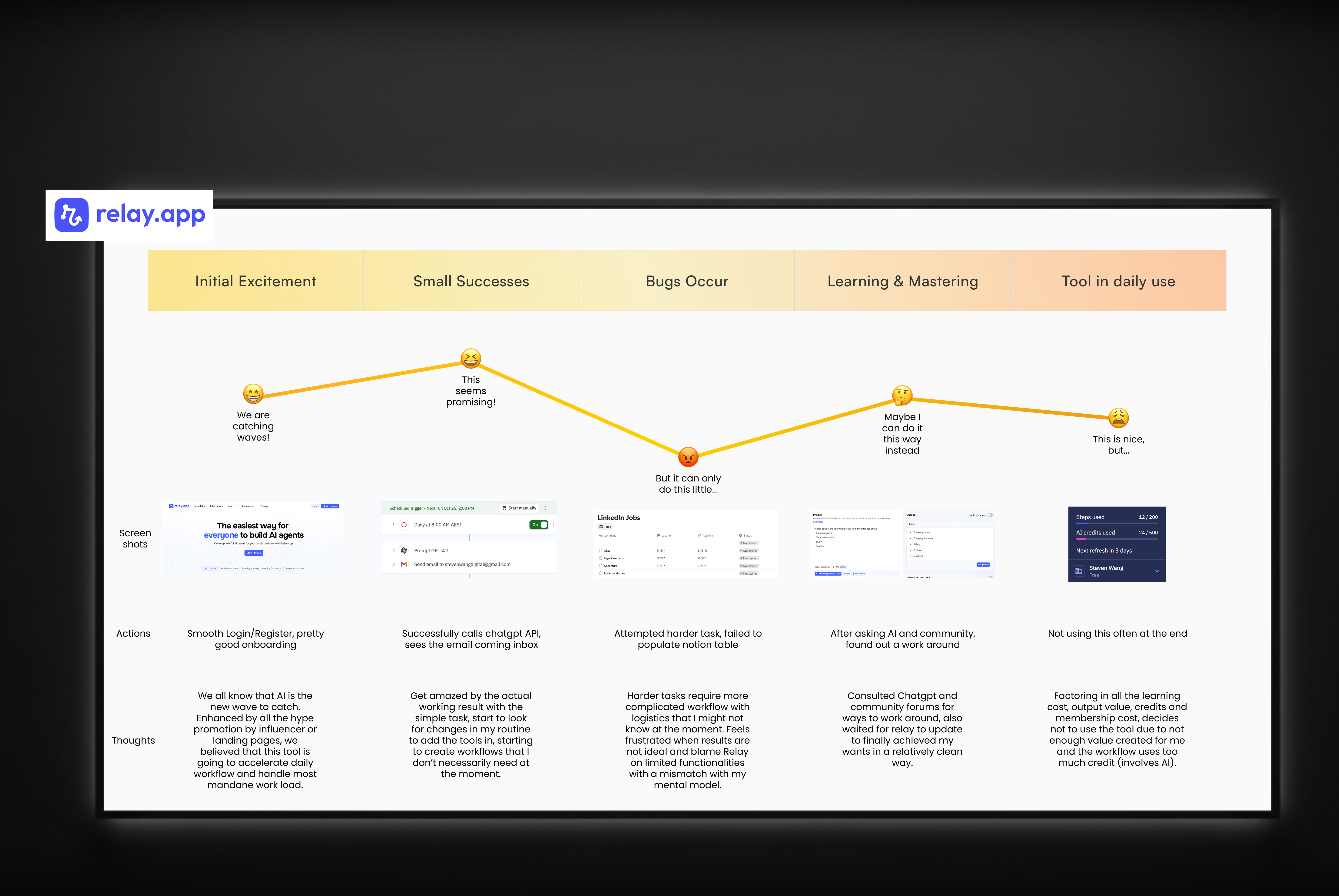
Among all products, I have used relay.app, an application focusing on RPA process (Robotic Process Automation) with the support of AI.
For example, the flow in the image on the left took me around 30 minutes to figure out and test, parsing all LinkedIn job board alerts to a designated page on notion for me to apply to jobs.
Move 2
User Journey Map
Remark:
On a side note, personally I think this is the best way to use user journey map instead of using it without personal experience or using it for testing design prototypes. This is more evidence-based, with more actual meanings and proven logic behind it, even though it is just one person's experience.
Move 2
Moving to explore others
With one of the tools in mind, that allows me to compare and contrast between tools and try my best to categorize them and generate an overall workflow for all categories.
Automation
Less AI (natural language) More logic building
More complicated to setup
Personal Assistance
More aspects than just social media management)
More AI (natural language) Less Integration
Project Planning

Less AI but more integrations
Aiming for smooth workflow
Move 2
Quantitative View
First we focus on how our scoped product are doing on a number basis.
| Youtube | Invest (in USD) | |||||
|---|---|---|---|---|---|---|
| Relevance AI | 3424 followers, around 3k views per post recently. | 9.15k subs. | 29K followers, 11-50 employees. | N/A | 93 followers. | 24M in series B, Total: 37M. |
| Sintra AI | 413 followers, around 300 views per post. | N/A | 8K followers, 11-50 employees. | 153K followers. | 172K followers. | 17M Seed. |
| Motion AI | 3774 followers, around 400 views per post. | 3.71k subs. | N/A | 310K followers. | 46K followers. | 13M in 2022. |
| Marblism AI | 1471 followers, not a lot of posts. | 99 subs. | 2K followers, 2-10 employees. | 1692 followers. | 517 followers. | Preseed: 500K in 2024. |
| UiPath | 105.2k followers, 1k views per post. | 66.2k subs. | 469K followers, 1k-5k employees. | 18.6k followers. | 50k followers. | On NYSE now. |
| Relay.app | 1170 followers, around 300 views per post. | 8.42k subs. | 6K followers, 2-10 employees. | 84 followers. | N/A | 3.1M Seed in 2023, Total: 8.1M. |
This would help us understand which tools are more similar to us and how we can relate to them. This could also make us know who is big in the market, our difference could lead to niche discovery.
Move 3
Qualitative Research Data Gathering
Then we will focus on authentic user feedback posted on Youtube, LinkedIn, Reddit, and other feedback platforms.


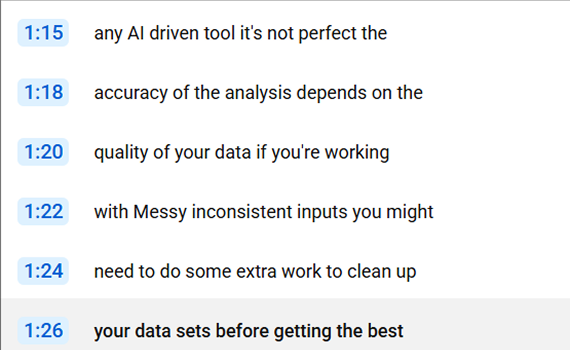

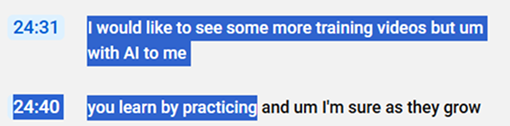




From here, we observe all kinds of needs, complaints, but also praises and encouragement.
There will be bias as some of the content might be paid, but since we are doing product competitor analysis, not commercial competitor analysis, these paid comments still provide an edge as they outline real live features that company would like to promote from the mouths of the influencers.
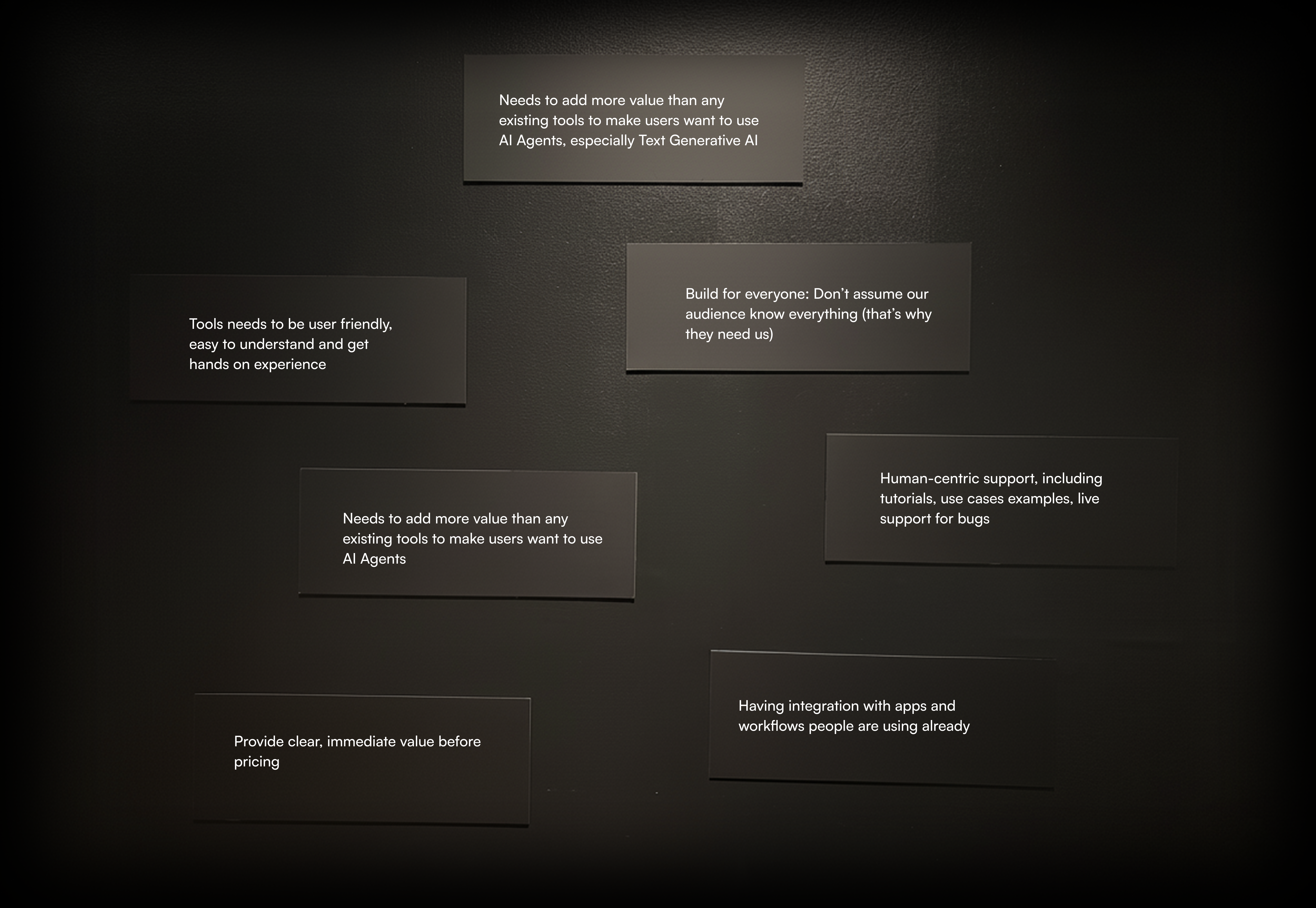
These are some key insights on what consumers would need from an AI agent, which is the core of the research.
Move 3
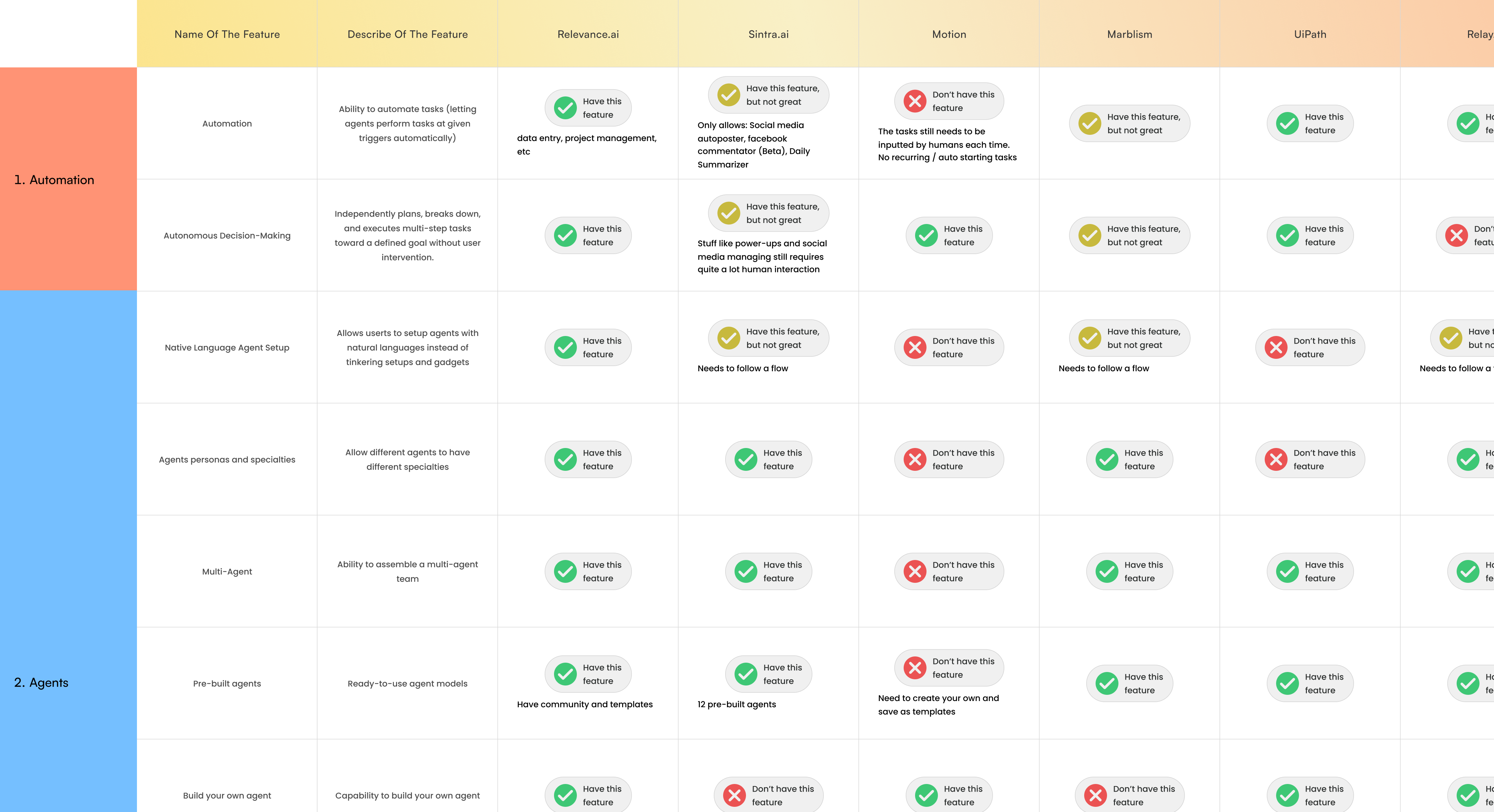
Feature List
Providing a feature list of all competitors, categorized into different parts of an AI agent.
Move 4
Result & Recommendations
Compiling all results into viable recommendations.
I always believe user research should go beyond data and visualizations, but offering strategic, vision-led recommendations that move the business forward.
NICHE
Start by mastering one clear use case, a niche, then expand.
Deliver a few standout features that truly impress, then expand by addressing adjacent needs within the same niche audience.
As an example, Zero is an AI-powered email client that manages your inbox, and that's all it is doing.
It could be just adding some AI features into a daily familiar interface.
Or having specific use cases displaying, could mitigate lots of confusion and smooth out the learning curves.


If the scope is big, sometimes it is also recommended to break functions to separate agents to handle individual cases, as long as users are well-educated.
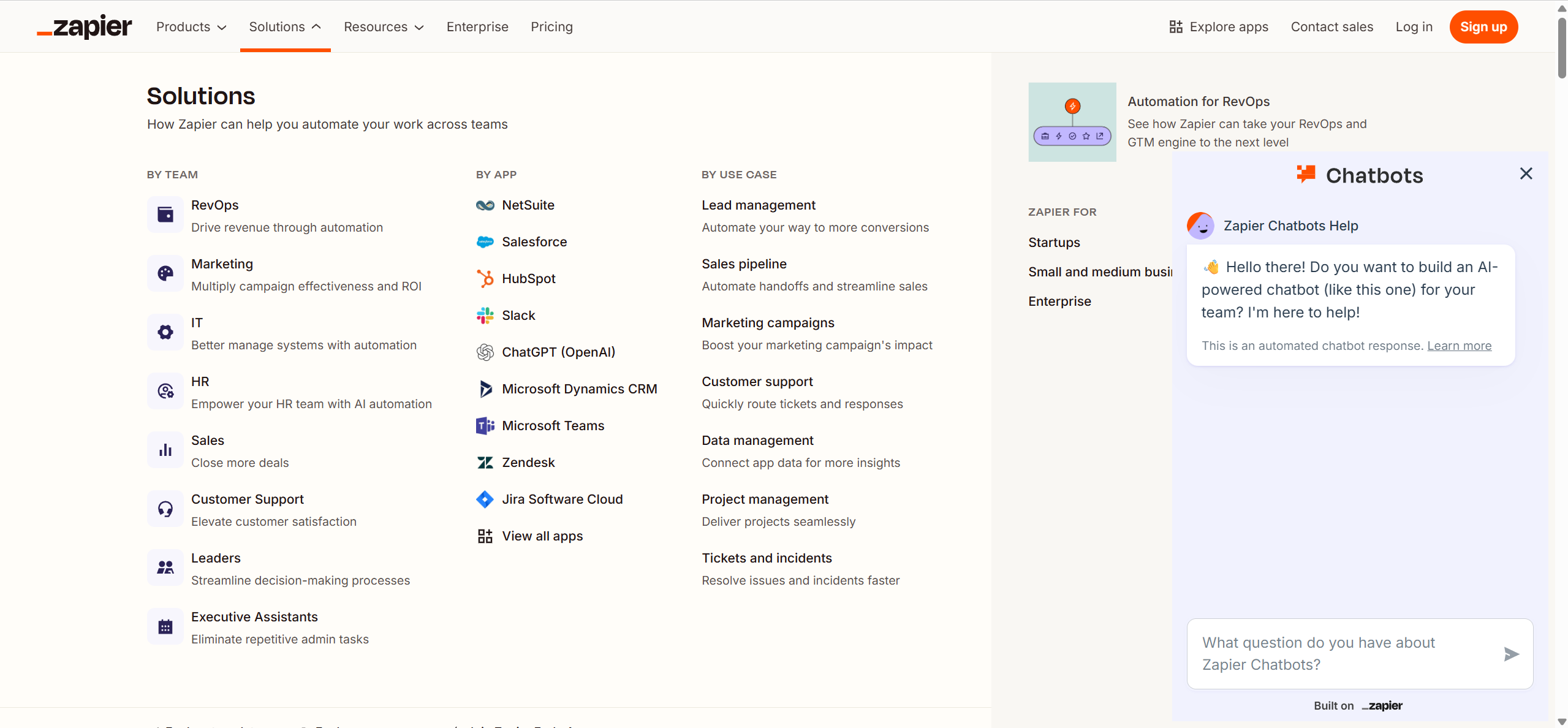
We also do recongize that other platforms might be aiming big and broad, like Google and Zapier for example, but that is not the case for us because we are not trying to be everything to everyone, yet.
EDUCATION
People might not be an expert in your field. That is why they need your support.
The biggest barrier to adoption is the learning curve. And the level of education resources and care given to the users would determine the level of adoption and promotion.
When talking about education, several of the following techniques would be mentioned. Onboarding. Tutorials. Help. (I specifically exclude documentation because that is usually for geeks, not for our target audience.)
Overall, we are looking at giving users enough examples to learn from, explanations on what the AI is doing and how it is benefiting, give alternatives to what users are prompting.
So we can see multiple products using landing pages and onboarding screens as a great way to start things off.
Furthermore, nothing explains better than a curated video. Hence, youtube videos are becoming a forefront of education resources comparing to boring documentations and manuals. It is also replacing other platforms like Facebook, Forums and reddit.

Eventually, we might also want to see other incentives for users to keep learning, creating, and thriving. This could give us more user data and channels to improve the product.
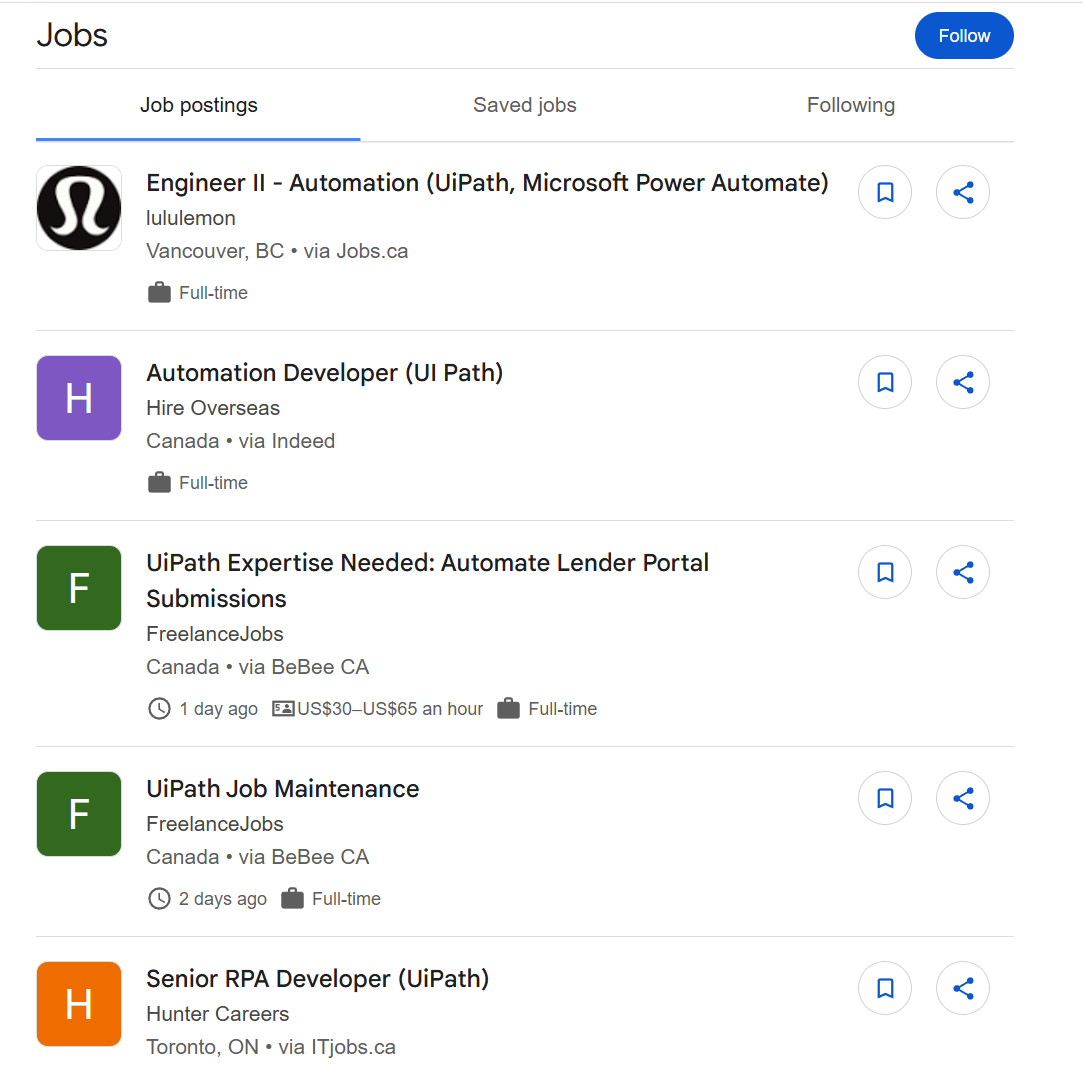
Hence, sometimes we might see companies offering positions that requires applicants to master the product to do the job. It would be the end goal, but a very promising one.
TRUST
The need to gain trust so that people are willing to give them complicated and impactful tasks.
As one of the most trendy topic in tech, AI agents never fail to gain attention. When we look at marketing, companies used conferences, demos, trailers or even blogs and posts to gain mass attention.

However, retention is the key to success as fads run fast. To gain retention, trust is our best friend.
In pre-AI world UX, trust means flows without friction, actions and responses carried out swiftly and accurately.
With AI, people start to get greedy. We want the AI to think with us, sometimes even taking the lead. That's why deep thinking ability becomes a milestone in AI development.
If AI fails to do that, We call them “dumb” and confirm that AI cannot replace human, close the window, end of product usage.
With agent, the bar would be even higher as most agents are separate products, meaning additional cost on top of ChatGPT or other daily tools.
Extra values need to be seen before full adoption, and it must go above and beyond the classic ones, aka ChatGPT.
There are some proven ways to succeed. Products like Sintra AI would focus on integrations, and UIPath would focus on automation. Those are all some good ways to gain trust by providing extra value than generative AI.
However, risks follows as the complexity increases and products fail to deliver and meet the level of expectations as marketed in their websites or blue sky presentations.
COMMUNITY
Build a strong community around your product, and engage.
Building a community is a longliving way to do marketing and promoting products, from physical stores to online SaaS.
Usually it means to have a forum or some ways for users to interact with each other regarding the product experience. In online SaaS product's scenario, it would also serve the purpose of customer support and feedback collection.
However, it doesn't need to stop there. We can also see companies providing communities for geeks to try to make a profit by helping others to use the product. An obvious example would be Framer / Webflow paid templates. By encouraging people to create and sell their own templates, they can make a profit by selling their templates to others; while the product could also increase its popularity and usage, especially when it can attract different types of users, such as entrepreneurs who are not familiar with the product but want to use it.
In AI world, we can see a great example such as Notion AI and Relevance AI marketplace.
Just like in the video, from marketplace to actual task in line, a few clicks and magic happens. This is what attracts so many people to see AI as life changing. And with a community, your product can replicate this hyper experience.
And by aligning the goal of the product with the community, we can see a big network effect and that would increase the leverage of the product.